By Chef Paprika
This article contains affiliate links. If you buy through them, itamae.fun may earn a small commission at no extra cost to you.
A Japanese knife is one of the best things you can bring home from Japan. You use it every day, and every time you do, you remember the trip. But standing in front of a wall of knives, with prices from a few thousand yen to far more, is not easy. Neither is getting the knife home.
I am Chef Paprika, an itamae (a chef of Japanese cuisine) with 23 years in professional kitchens: ryotei in central Tokyo, a Michelin-starred restaurant, and a members-only club. I also hold a Tokyo fugu license. A knife is the most important tool I own, and I have bought my share of them, including two that ended up retired in a drawer.
This guide covers what to decide before you go, where knives are sold, what to ask in the shop (with simple Japanese phrases), engraving, tax-free shopping, and flying home with your knife. I do not name or recommend any shop. Choose one where the staff take time to listen to you.
Before you go: decide five things
You will enjoy the shop much more if you have already thought about these.
1. Shape: what do you want to cut?
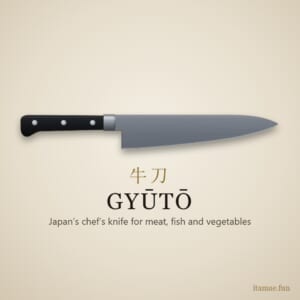
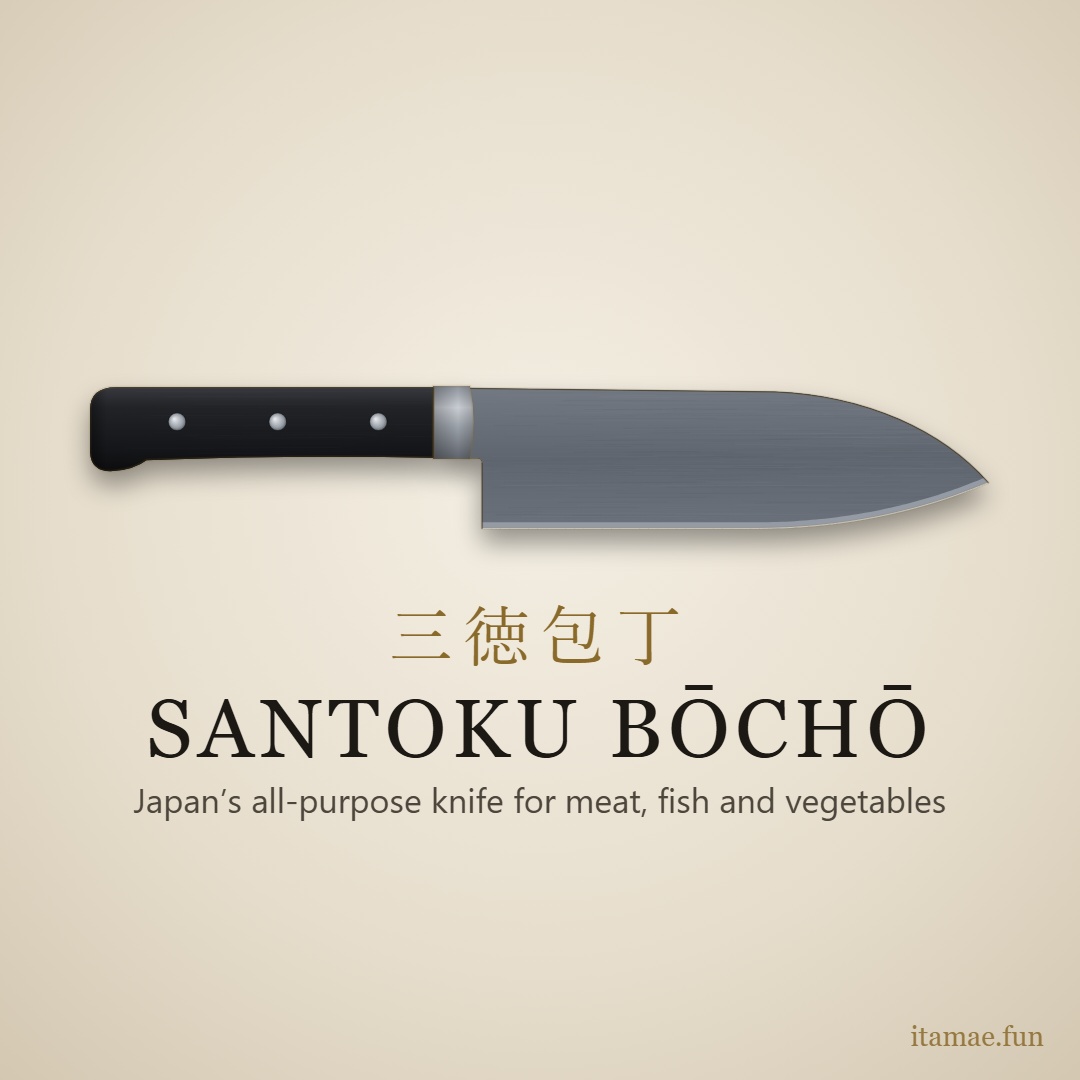
For one knife for a home kitchen, I recommend a santoku, the all-purpose knife of Japanese homes. If you want a longer chef’s knife, look at a gyuto. For mostly vegetables, a nakiri. My comparison is here: Gyuto vs Santoku (vs Nakiri and Bunka).
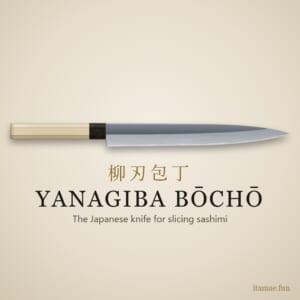
If you want a traditional sashimi or fish knife, such as a yanagiba or deba, read Japanese Knife Types and Names first. These are specialist tools.
2. Steel: carbon or stainless?
- Carbon steel (hagane): very sharp and easy to sharpen, but it rusts quickly from water and acid.
- Stainless steel: resists rust and needs less care.
If you do not want to worry about rust, choose stainless. If you choose VG-10, buy from a shop you trust, because there are many fakes. If you want to learn carbon steel, White #2 is a balanced, reasonably priced steel.
3. Single or double bevel?
- Double-bevel knives (santoku, gyuto, nakiri, petty) are sharpened on both sides. They work in either hand and are the easy place to start.
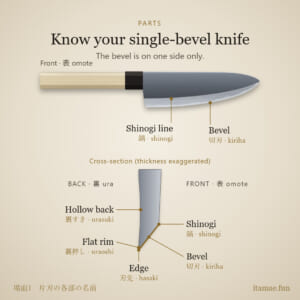
- Single-bevel knives (yanagiba, deba, usuba) are sharpened on one side. They are made for one hand, and sharpening them takes practice. See How to Sharpen a Single-Bevel Japanese Knife.
If you are left-handed and want a single-bevel knife, tell the shop. A right-handed single-bevel knife is not the same knife turned around. Left-handed versions exist, but a shop may not have one in stock.
4. Length and handle
Blade lengths vary. Hold the knife if the shop lets you. Handles come in Japanese style (light, usually wood) and Western style (riveted, heavier). Neither is “correct”; choose the one that feels steady in your hand.
5. Budget
For a proper Japanese-made santoku, expect to pay about ¥10,000 to ¥20,000. Decide your limit before you go, and tell the staff.
Where knives are sold
- Kappabashi, Tokyo: a street of shops selling kitchen tools to restaurants and home cooks, including many knife shops.
- Sakai, near Osaka: a knife-making city with a long history of making blades.
- Other places: department stores, kitchen-tool shops, and the knife-making towns of other regions.
You will find knives at many prices in all of these places. I cannot judge a shop for you from far away, so here is what I would look for instead:
- Staff who ask what you want to cut before they show you a knife.
- Clear information on the steel, the bevel and the maker.
- Sharpening and aftercare offered in the shop.
In the shop: questions to ask
Tell the staff what you want to cut and what your budget is. Then they can show you the right knife. Here are simple phrases. Showing this page on your phone works too.
| English | Japanese (romaji / Japanese script) |
|---|---|
| I’m looking for a santoku. | Santoku bōchō o sagashite imasu. / 三徳包丁を探しています。 |
| I mainly cut vegetables (meat / fish). | Omo ni yasai (niku / sakana) o kirimasu. / 主に野菜(肉・魚)を切ります。 |
| My budget is about 20,000 yen. | Yosan wa niman-en kurai desu. / 予算は2万円くらいです。 |
| Is this carbon steel or stainless? | Kore wa hagane desu ka, sutenresu desu ka? / これは鋼ですか、ステンレスですか。 |
| Does it rust? | Sabimasu ka? / 錆びますか。 |
| Is it single-bevel or double-bevel? | Kataba desu ka, ryōba desu ka? / 片刃ですか、両刃ですか。 |
| I’m left-handed. | Hidari-kiki desu. / 左利きです。 |
| May I hold it? | Motte mite mo ii desu ka? / 持ってみてもいいですか。 |
| Can you engrave my name? | Na-ire dekimasu ka? / 名入れできますか。 |
| Could you sharpen it for me? | Hatsuke o onegai dekimasu ka? / 刃付けをお願いできますか。 |
| Can I buy it tax-free? | Menzei de kaemasu ka? / 免税で買えますか。 |
| I’m flying home. Please pack it well. | Hikōki de kaerimasu. Shikkari tsutsunde kudasai. / 飛行機で帰ります。しっかり包んでください。 |
Four things I would ask for when buying
From my own experience, these make the difference:
- Tell the staff what you want to cut and your budget.
- Have your name engraved on the blade. It makes a lovely souvenir.
- Ask them to sharpen it (put a fresh edge on it) when you buy it.
- Ask them to pack it for travel, in a saya (sheath) or a box.
About engraving
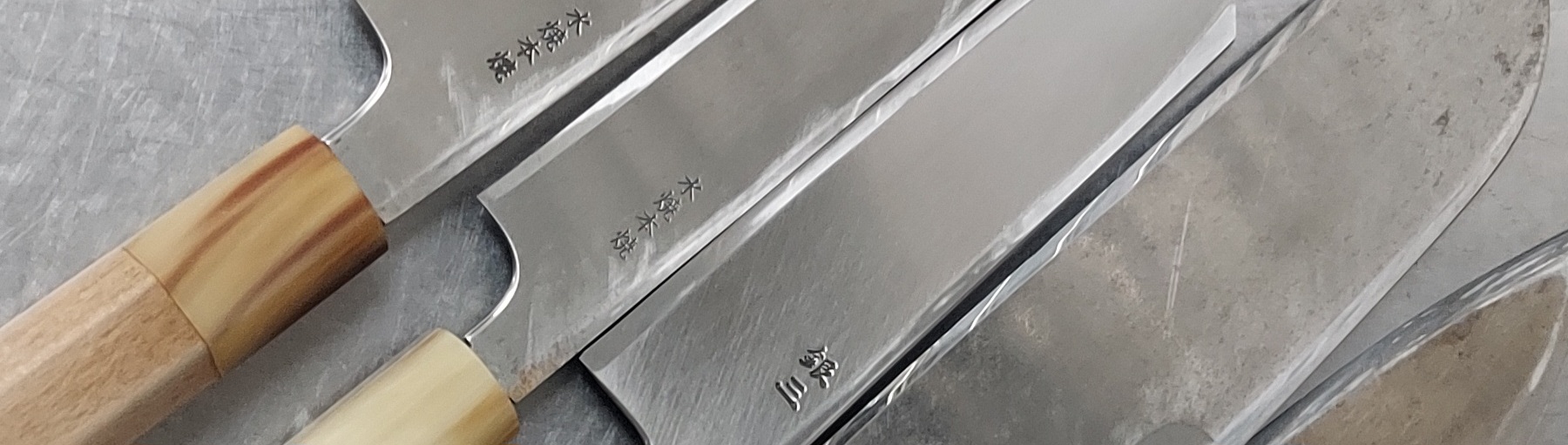
Many shops can engrave a name on the blade, often in Japanese characters. Some do it while you wait; at others it takes longer, so ask how long before you pay, especially if you are short on time.
Tax-free shopping (new system from November 1, 2026)
Japan changed its tax-free system on November 1, 2026. Here is what the Japan Tourism Agency’s page for travelers says (as of November 17, 2026):
- You now pay the tax-inclusive price in the shop. The tax is refunded later, after customs confirms at departure that you are taking the goods out of Japan. Ask the shop how and when the refund is paid.
- The customs confirmation must be done within 90 days of the purchase date.
- The minimum is ¥5,000 or more (excluding tax) per day at the same store.
- At the airport or seaport, you show your passport at a tax-free procedure terminal, and you must have all the tax-free goods with you. If one item from a receipt is missing, none of the goods on that receipt can be refunded.
- You cannot get baggage back once you have checked it with an airline, so the page tells you to finish the procedure before check-in. At some major airports you can also do it online through Visit Japan Web, before the security checkpoint.
What this means for a knife: a knife cannot go in your carry-on bag (see below), but it must be with you for the tax-free confirmation. So go to the tax-free procedure first, with the knife still in its box, and check it in with your bag afterwards. Leave extra time at the airport.
Rules can change. Check the official page before you travel: Japan Tourism Agency: tax-free shopping for travelers.
If the shop ships the knife to you abroad: whether shipped goods can be bought tax-free is not covered on the official page. Ask the shop.
Flying home with your knife
The rules that matter here come from Japan’s Ministry of Land, Infrastructure, Transport and Tourism (MLIT) and from your airline.
- Do not put a knife in your carry-on bag. MLIT explains that knives and other blades can be used in hijacking or terrorism, so some cannot be carried into the cabin. A kitchen knife is exactly that kind of item. (MLIT: restricted items)
- Taking restricted items into the cabin is an offense under Japan’s Civil Aeronautics Act. MLIT lists the penalty as up to 2 years’ imprisonment or a fine of up to ¥1,000,000. (MLIT: security screening)
- Pack the knife in your checked baggage. MLIT has said that knives not allowed in the cabin can be carried as checked baggage when properly packed and handed to the airline. (MLIT notice, 2002) Keep it in its saya or box, wrapped so the edge cannot cut through the bag or hurt anyone who opens it.
- Check with your airline. MLIT notes that airlines may have stricter rules and tells travelers to ask their airline whether an item can be carried on or checked.
- Check your home country’s customs rules before you fly. Some countries limit certain blades. I cannot cover every country, so look at your own customs office’s website.
In the city: keep your new knife boxed and wrapped in your bag until you are back at your hotel. Do not take it out to show friends on the street or on the train.
Not traveling soon? Online shops ship worldwide
If you cannot come to Japan, or would rather not carry a knife through airports, many Japanese online knife shops ship worldwide. You do not get to hold the knife first, so read the steel, the bevel and the length carefully, and check your country’s import rules and any duties.
Browse Japanese knives that ship worldwide from Japan
Aftercare: looking after your new knife
- Wash and dry it by hand straight after use. Especially carbon steel.
- Use a wooden or soft plastic cutting board. Never glass, stone or metal.
- Do not use it on bones or frozen food, and do not twist the blade. A thin Japanese edge can chip.
- Store it safely, in the saya, on a magnetic strip or in a block.
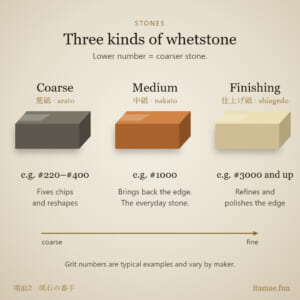
- Sharpen on whetstones. For your first stone, a medium stone around #1000 is the one to start with. See my sharpening guide.
- Carbon steel will change color with use. A grey or dark film is normal; red rust is not. Wipe the knife dry, and remove rust early.
A medium #1000 whetstone to start with
FAQ
Which knife should I buy as my first one in Japan? For a home kitchen, I recommend a santoku. A proper Japanese-made one costs about ¥10,000 to ¥20,000.
Can I take a Japanese knife in my carry-on? No. Put it in your checked baggage, packed in its saya or box. Check your airline’s rules and your home country’s customs rules before you fly.
Can I still buy a knife tax-free? Yes, under the new refund system from November 1, 2026, if you spend ¥5,000 or more (excluding tax) at one store in a day. You pay the full price in the shop, and the tax is refunded after customs confirmation at departure, within 90 days. Do the procedure before you check in your bag, because the knife must be with you.
Should I get my name engraved? I would. It makes a lovely souvenir. Ask how long it takes before you pay.
Carbon steel or stainless? If you do not want to worry about rust, stainless. If you want to learn carbon steel and will dry the knife every time, White #2 is a good start.
I am left-handed. Does it matter? For double-bevel knives like the santoku and gyuto, not much. For single-bevel knives, yes: tell the shop you are left-handed.
Take your time
A good knife lasts for years. Decide what you want to cut, set a budget, ask questions, and hold the knife before you buy. Then pack it carefully for the flight home, and enjoy cooking with it in your own kitchen.
More from my kitchen: