By Chef Paprika
This article contains affiliate links. If you buy through them, itamae.fun may earn a small commission at no extra cost to you.
“Gyuto or santoku?” It is one of the questions I hear most from people who want their first Japanese knife. And then come two more names: nakiri and bunka.
I am Chef Paprika, an itamae (a chef of Japanese cuisine) with 23 years in professional kitchens: ryotei in central Tokyo, a Michelin-starred restaurant, and a members-only club. I also hold a Tokyo fugu license.
All four of these knives are double-bevel (sharpened on both sides), which makes them much easier to start with than the traditional single-bevel knives like the yanagiba and deba. In this guide I compare their shapes, lengths, what each one is good at, and who should pick which. Where I give my own opinion, I say so.
The short answer
- If you want one knife for a home kitchen, choose a santoku. It is the all-purpose knife of Japanese homes, and it is my pick for a first knife.
- If you cook a lot, cut large pieces of meat, or work in a professional kitchen, look at a gyuto.
- If you mostly cut vegetables, a nakiri is worth a look.
- If you like the santoku idea but want a sharper point for fine work, look at a bunka.
The four knives at a glance
| Knife | Shape and typical length | Best at |
|---|---|---|
| Gyuto (牛刀) | Long, pointed chef’s knife; about 180–270 mm | Meat, fish, fruit and citrus, vegetables: an all-rounder |
| Santoku (三徳) | Shorter, taller blade with a rounded tip; about 165–180 mm | Meat, fish and vegetables in a home kitchen |
| Nakiri (菜切り) | Rectangular blade with a flat edge; about 165 mm | Vegetables: straight chopping and thin slicing |
| Bunka (文化) | Like a santoku, with an angled, pointed tip; about 165–180 mm | All-purpose, plus fine work with the tip |
Lengths are typical blade lengths. They vary from maker to maker.
Gyuto (牛刀): the Japanese chef’s knife
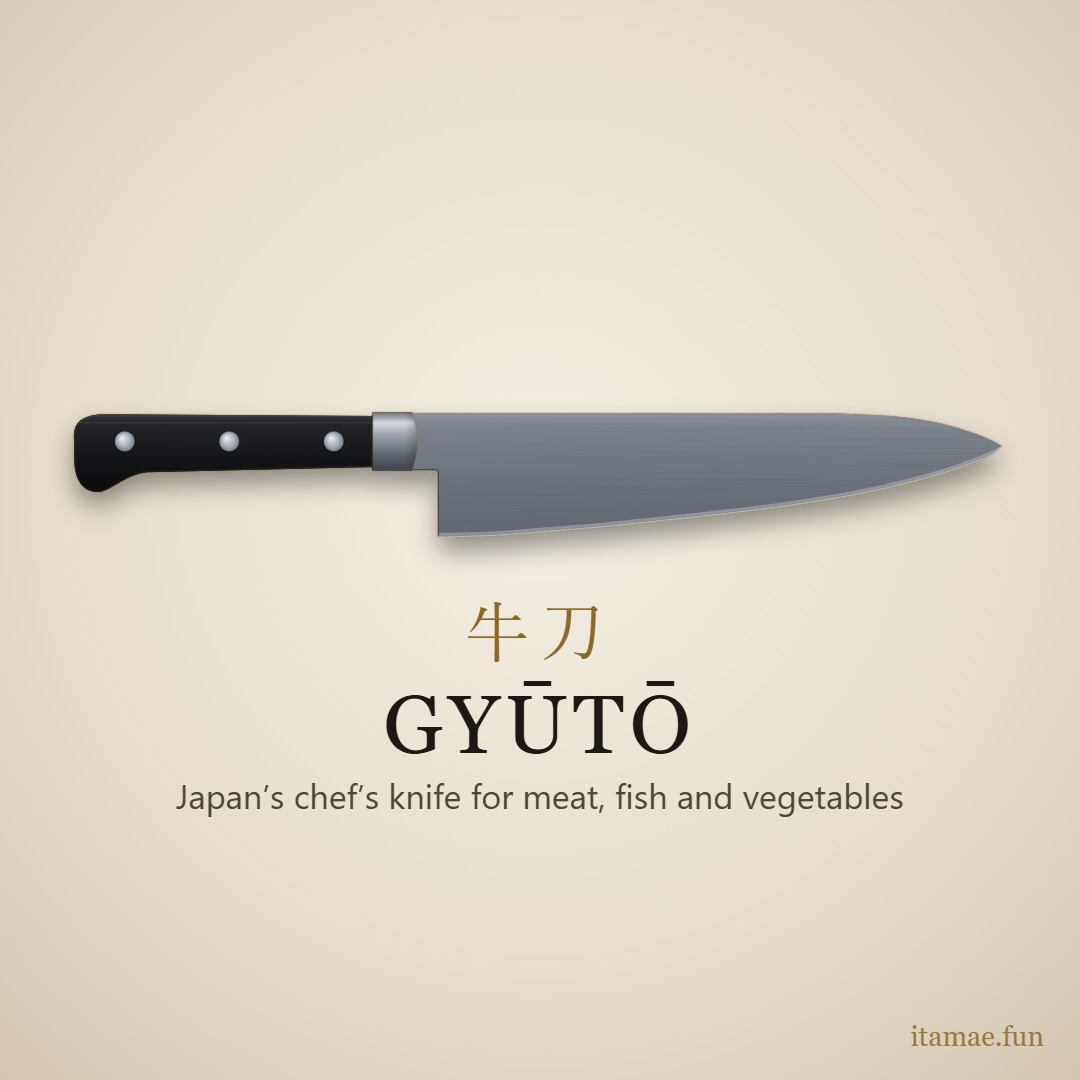
Gyuto means “beef sword.” It is a Western-style chef’s knife, but it works hard in Japanese kitchens too. Handles come in both Japanese and Western styles.
- Shape: long, with a pointed tip and a gentle curve toward the tip.
- Good at: a bit of everything. A long blade lets you slice through a large piece of meat or a big vegetable in one stroke.
- Acid: a stainless gyuto stands up to the acid of fruit and citrus. A carbon-steel gyuto does not; wipe it as you go. (Gyuto is the name of a shape, not a steel. You can buy it in either.)
- In my world: many itamae own a gyuto in molybdenum stainless steel (for example AUS-8).
Who it suits: cooks who are comfortable with a longer blade and have the counter space to use it.
Browse gyuto (Japanese chef’s knives) · a stainless VG10 gyuto
Gyuto (牛刀): Japan’s chef’s knife for meat, fish and vegetables.
Santoku (三徳): the all-purpose knife of Japanese homes
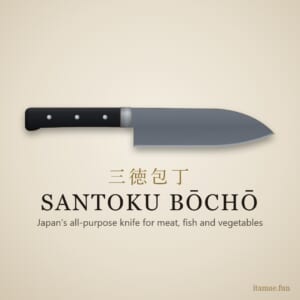
You will find a santoku in most Japanese homes. The name means “three virtues”: it handles meat, fish and vegetables.
- Shape: usually shorter than a gyuto, with a taller blade and a rounded tip.
- Good at: the everyday cutting of a home kitchen. It is easy to control.
- Price: for a proper Japanese-made santoku, expect to pay about ¥10,000 to ¥20,000.
Who it suits: home cooks, and anyone buying their first Japanese knife. This is the knife I recommend if you want just one.
Santoku (三徳): Japan’s all-purpose knife for meat, fish and vegetables.
Browse santoku knives (stainless and carbon steel)
Nakiri (菜切り): the home vegetable knife
Nakiri means “greens cutter.”
- Shape: a rectangular blade with a flat, straight edge, and no point.
- Good at: chopping vegetables straight up and down, so the whole edge meets the board at once.
- Compared with the usuba: the usuba is the professional’s single-bevel vegetable knife, and one of the hardest knives to sharpen. The nakiri is double-bevel, so it is much easier to look after.
- Not for: fish bones or hard work with the tip. It has no tip to speak of.
Who it suits: people who cut mainly vegetables, and who already have, or do not need, a knife with a point.
Bunka (文化): a santoku with a point
Bunka means “culture.”
- Shape: close to a santoku in length and height, but with an angled, pointed tip.
- Good at: the same everyday jobs as a santoku, plus fine work with the tip, such as scoring or small cuts.
Who it suits: home cooks who like the size of a santoku but want a sharper point.
And the petty knife
Whichever you choose, a petty knife (blade 15 cm or less) is a useful second knife for small jobs, peeling and fine decorative cuts.
Gyuto vs santoku: side by side
| Gyuto | Santoku | |
|---|---|---|
| Length | Longer | Usually shorter |
| Tip | Pointed | Rounded |
| Control | Takes a little practice | Easy to control |
| Big jobs (large meat, big vegetables) | Better: one long stroke | Fine for home portions |
| Small kitchen, small cutting board | Can feel long | A good fit |
| My pick for a first knife | Second choice | First choice |
Santoku vs nakiri vs bunka
| Santoku | Nakiri / Bunka | |
|---|---|---|
| Meat and fish | Yes | Nakiri: not really. Bunka: yes |
| Vegetables | Yes | Nakiri: its specialty. Bunka: yes |
| Tip work | Limited (rounded tip) | Nakiri: none. Bunka: good |
Steel: a quick, high-level guide
The shape tells you what a knife is for. The steel tells you how it behaves: how sharp, how easy to sharpen, and whether it rusts. Any of these four shapes can come in either family.
- Carbon steel (hagane): very sharp and easy to sharpen, but it rusts quickly from water and acid. The common Japanese grades are White (shirogami) and Blue (aogami). Blue is White with chromium and tungsten added, for longer edge life.
- Stainless steel: resists rust and needs less care. Common names you will see: molybdenum steel (for example AUS-8), Ginsan (Silver #3), VG-10 and SG2.
About hardness numbers. The steel makers publish a minimum hardness after heat treatment, for example HRC 60 or more for White and Blue steels, 59 or more for Ginsan, 60 or more for VG-10 and 62 or more for SG2. These are values for the steel, not for the finished knife. The final hardness depends on how the smith heat-treats it, so two knives of the same steel can differ.
My view, from my knife types guide:
- If you do not want to worry about rust, choose stainless. Ginsan feels close to carbon steel and is easy to sharpen. If you choose VG-10, buy from a shop you trust, because there are many fakes.
- If you want to learn carbon steel, White #2 is a balanced, reasonably priced steel that is good enough for professional work.
- Leave the hardest steels for later, when your sharpening skills and stones are ready.
For a first santoku or gyuto for a home kitchen, I would choose stainless.
For the full steel tables, see Japanese Knife Types and Names.
Safety and care for any of these knives
- Use a wooden or soft plastic cutting board. Never glass, stone or metal.
- Do not twist the blade or use it on bones or frozen food. A thin Japanese edge can chip.
- Wash and dry the knife by hand straight after use, and keep it out of the dishwasher. This matters most for carbon steel.
- Keep it on a magnetic strip, in a block, or in a sheath (saya). Never loose in a drawer.
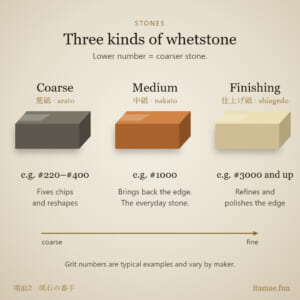
- Sharpen on whetstones. These four knives are double-bevel, so you sharpen both sides. My sharpening guide is for single-bevel knives, but the basics (choosing stones, preparing them, the burr, and safety) are the same.
FAQ
Is a gyuto or a santoku better for beginners? For most home cooks, a santoku. It is shorter and easy to control, and it handles meat, fish and vegetables. It is my pick for a first knife.
Can a santoku cut meat and fish? Yes. That is where the name comes from: “three virtues,” meaning meat, fish and vegetables.
Is a nakiri the same as an usuba? No. Both are vegetable knives, but the usuba is a professional single-bevel knife and very hard to sharpen. The nakiri is double-bevel and easier to look after.
Are these knives OK for left-handed cooks? Generally yes. All four are double-bevel, so they work in either hand, but ask the shop: some have a right-handed handle or edge. (Single-bevel knives like the yanagiba and deba are made for one hand.)
Carbon or stainless for my first one? If you do not want to worry about rust, stainless. If you want to learn carbon steel, White #2 is a good place to start.
Where can I buy one? In Japan, in places like Kappabashi in Tokyo or Sakai near Osaka, or from online shops that ship worldwide. See How to Buy a Japanese Knife in Japan.
Choose for the way you cook
There is no single best knife. A santoku is the easiest place to start, a gyuto gives you reach for bigger work, a nakiri is a vegetable specialist, and a bunka adds a point to the santoku idea. Think about what you cut most, how much space you have, and how much care you want to give a knife. Then choose the one you will enjoy using every day.
Compare santoku · and gyuto knives from Japan
More from my kitchen:
- Japanese Knife Types and Names, Explained by a Working Itamae: all the knife shapes, steels and parts.
- How to Sharpen a Single-Bevel Japanese Knife, Step by Step: whetstones, the burr and safety.
- How to Buy a Japanese Knife in Japan: A Working Itamae’s Guide for Travelers
- How to Cut a Tuna Block into Saku (Sashimi Blocks): A Professional Itamae’s Method