By Chef Paprika
This article contains affiliate links. If you buy through them, itamae.fun may earn a small commission at no extra cost to you.
Look closely at the edge of a Japanese knife and you will find one of two things. Either the blade is ground on both sides, like most Western knives, or it is ground on one side only. That is the difference between a double-bevel and a single-bevel knife, and it changes how the knife cuts, how you sharpen it, and which hand it is made for.
I am Chef Paprika, an itamae (a chef of Japanese cuisine) with 23 years in professional kitchens. I use both kinds every day. In this guide I explain the difference in plain words, and help you decide which kind you need. Where I give my own opinion, I say so.
The short answer
- A double-bevel knife is sharpened on both sides. Santoku, gyuto and petty knives are double-bevel. They are easy to use and easy to sharpen, and they generally work in either hand.
- A single-bevel knife is sharpened on one side only. Yanagiba (sashimi knife), deba (fish knife) and usuba (vegetable knife) are single-bevel. They are the traditional knives of the Japanese professional kitchen, made for precise cuts, and made for one hand.
- For a first Japanese knife, choose a double-bevel knife. My pick is a santoku.
- Choose a single-bevel knife when you want to do a specific job well, such as slicing sashimi or breaking down whole fish, and you are ready to learn a different way of sharpening.
What “bevel” means
The bevel is the angled face that runs down to the cutting edge.
- On a double-bevel knife, both sides are angled toward the edge, which sits in the middle.
- On a single-bevel knife, one side (the front, omote) has a wide bevel. The other side (the back, ura) is almost flat, with a slight hollow in the middle.
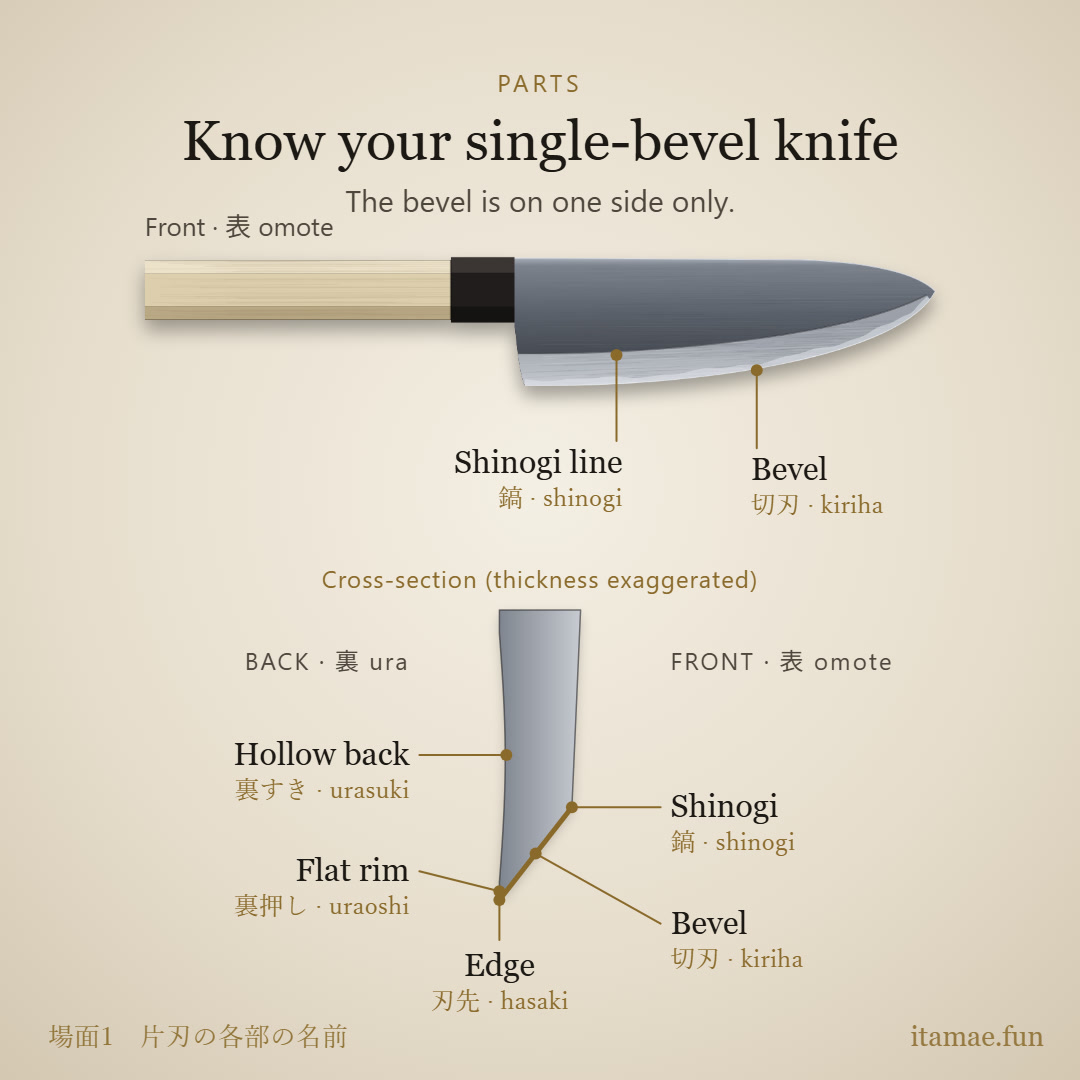
| Part | Japanese | What it is |
|---|---|---|
| Front | 表 (omote) | The side with the bevel. |
| Bevel | 切刃 (kiriha) | The wide, angled face that runs down to the edge. |
| Shinogi line | 鎬筋 (shinogi-suji) | The line where the bevel begins. |
| Back | 裏 (ura) | The other side. It is not perfectly flat. |
| Back hollow | 裏すき (urasuki) | A slight hollow in the middle of the back. |
| Flat rim | 裏押し (uraoshi) | The narrow flat band around the hollow, along the edge. |
Which Japanese knives are which
| Knife | Japanese | Bevel | Main use |
|---|---|---|---|
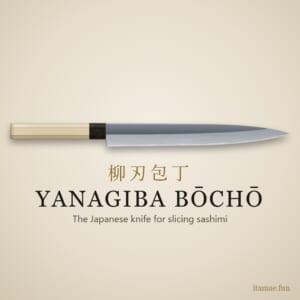
| Yanagiba | 柳刃 | Single | Slicing sashimi in one long pull |
| Deba | 出刃 | Single | Breaking down whole fish, cutting through bones |
| Usuba | 薄刃 | Single | Vegetables: precise cuts and katsuramuki (peeling daikon into a thin sheet) |
| Takohiki | 蛸引 | Single | Slicing sashimi (Kanto style) |
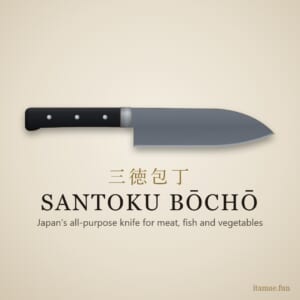
| Santoku | 三徳 | Double | Meat, fish and vegetables: the all-purpose knife of Japanese homes |
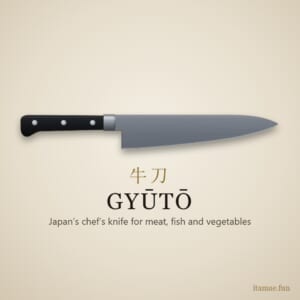
| Gyuto | 牛刀 | Double | Meat, fish, fruit and vegetables: the Japanese chef’s knife |
| Petty knife | ペティナイフ | Double | Small jobs and fine cuts (blade 15 cm or less) |
| Nakiri | 菜切り | Double | Vegetables: the home vegetable knife (see Gyuto vs Santoku) |
For more knife types, see Japanese Knife Types and Names.
How they cut differently
A double-bevel knife splits the food more or less evenly to both sides. It is forgiving, and it goes straight down when you chop. That is why it suits everyday cooking.
A single-bevel knife has one flat side. That flat back is what lets a yanagiba slice sashimi in one long pull and leave a clean, shiny cut face, and lets an usuba peel a daikon into a thin, even sheet.
The trade-off: because one side is flat, a single-bevel knife tends to drift a little to one side when you cut straight down. With practice you learn to control it.
Browse yanagiba (sashimi knives) · A 270 mm yanagiba in white steel
Sharpening: the biggest practical difference
Double-bevel: you sharpen both sides. It is the easier of the two to learn.
Single-bevel: you sharpen the front a lot and the back only a little.
- On the front, the bevel itself sets the angle: lay the whole bevel flat on the stone.
- On the back, a few light strokes on a finishing stone take off the burr. Do not lift the spine, or you will put a bevel on the back.
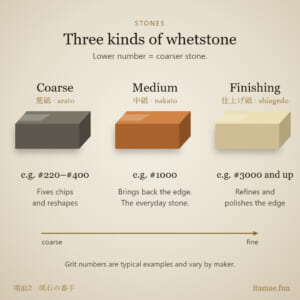
The step-by-step routine for single-bevel knives is in my sharpening guide. Those 8 steps are for single-bevel knives only; do not use them on a santoku or gyuto. The choice of stones is the same for both kinds: see the whetstone grit guide.
Left-handed? Read this before you buy
Double-bevel knives generally work in either hand. Even so, ask the shop: some have a handle or an edge made for the right hand.
Single-bevel knives are made for one hand. A standard yanagiba, deba or usuba is made for right-handed use: the bevel is on the right-hand face of the blade as you hold it. For left-handed cooks, makers offer left-handed versions, with the bevel on the other side. They are often made to order and can cost more, so ask before you buy, and allow extra time.
A left-handed person should not use a right-handed single-bevel knife “the other way round.” The cut will drift, and the knife will not work as it should.
Which one should you choose?
| Double-bevel | Single-bevel | |
|---|---|---|
| Examples | Santoku, gyuto, petty | Yanagiba, deba, usuba |
| Best for | Everyday cooking: meat, fish and vegetables | One job done very well: sashimi, whole fish, fine vegetable work |
| Ease of use | Easy | Takes practice |
| Sharpening | Both sides; easier to learn | Front a lot, back a little; a finishing stone for the back |
| Left-handed | Generally fine (check the handle) | Needs a left-handed version |
| My pick for a first knife | First choice (a santoku) | Later, for a specific job |
My view:
- Your first Japanese knife should be double-bevel. A santoku is the all-purpose knife of Japanese homes, and it is what I recommend.
- Add a single-bevel knife when you have a job for it. If you want to slice sashimi, a yanagiba. If you break down whole fish, a deba.
- For a carbon-steel single-bevel knife, start with kasumi (hard steel joined to soft iron), not honyaki (all hard steel). Leave honyaki for later, when your sharpening and stones are ready.
Start with a santoku (double-bevel) · A stainless VG-10 santoku
Single-bevel: deba knives · usuba knives · A white-steel deba · A white-steel usuba
Not sure which shape or steel suits you? My free app asks 7 quick questions: Find your Japanese knife.
FAQ
Is a single-bevel knife sharper than a double-bevel knife? Not simply “sharper.” A single-bevel knife is made for clean, precise cuts in particular jobs, such as sashimi. A good double-bevel knife is very sharp too. Choose by the job, not by sharpness.
Can I use a single-bevel knife for everyday cooking? You can, but it is not what it is made for. A deba is thick and heavy for fish bones, and a yanagiba is long and slender for sashimi. For everyday cooking, a santoku or gyuto is easier.
Is a gyuto single or double bevel? Double. Gyuto, santoku, petty and nakiri are all double-bevel.
Can a left-handed person use a single-bevel knife? Yes, but buy a left-handed version. A standard single-bevel knife is made for the right hand.
Do I need different stones for a single-bevel knife? The same stones work, but you need a finishing stone for the back. See the whetstone grit guide.
Why do Japanese chefs use single-bevel knives? Japanese cuisine values the cut itself: the clean face of a slice of sashimi, a thin and even sheet of daikon. Single-bevel knives grew out of that.
One bevel or two: choose by the job
A double-bevel knife is the easy, all-round choice, and the right place to start. A single-bevel knife is a specialist: harder to learn and to sharpen, but made for cuts that are hard to get any other way. Start with a santoku, learn to keep it sharp, and add a yanagiba or deba when you have a job for it.
More from my kitchen:
- Whetstone Grit Guide: Which Stone (1000, 3000, 6000) Should You Use?
- How to Sharpen a Single-Bevel Japanese Knife, Step by Step
- Gyuto vs Santoku (vs Nakiri and Bunka): Which Japanese Knife Should You Choose?
- Japanese Knife Types and Names, Explained by a Working Itamae
- How to Cut a Tuna Block into Saku (Sashimi Blocks): A Professional Itamae’s Method