By Chef Paprika
This article contains affiliate links. If you buy through them, itamae.fun may earn a small commission at no extra cost to you.
You ate something wonderful in Japan, and now you want to take a little of it home. The shops make it easy: beautiful packages, tasting samples, everything wrapped for travel. The hard part comes later, at the airport, or at customs in your own country.
I am Chef Paprika, an itamae (a chef of Japanese cuisine). I have worked in Japanese kitchens for 23 years, including ryotei (traditional high-end Japanese restaurants), a Michelin-starred restaurant and a members-only club. In this guide I tell you what I would pack as a cook, and I explain the Japanese official rules that matter when you leave. The rules of your own country decide what you may bring in, and I cannot cover every country, so always check them yourself. I name no shops or brands, only types of products.
The short answer
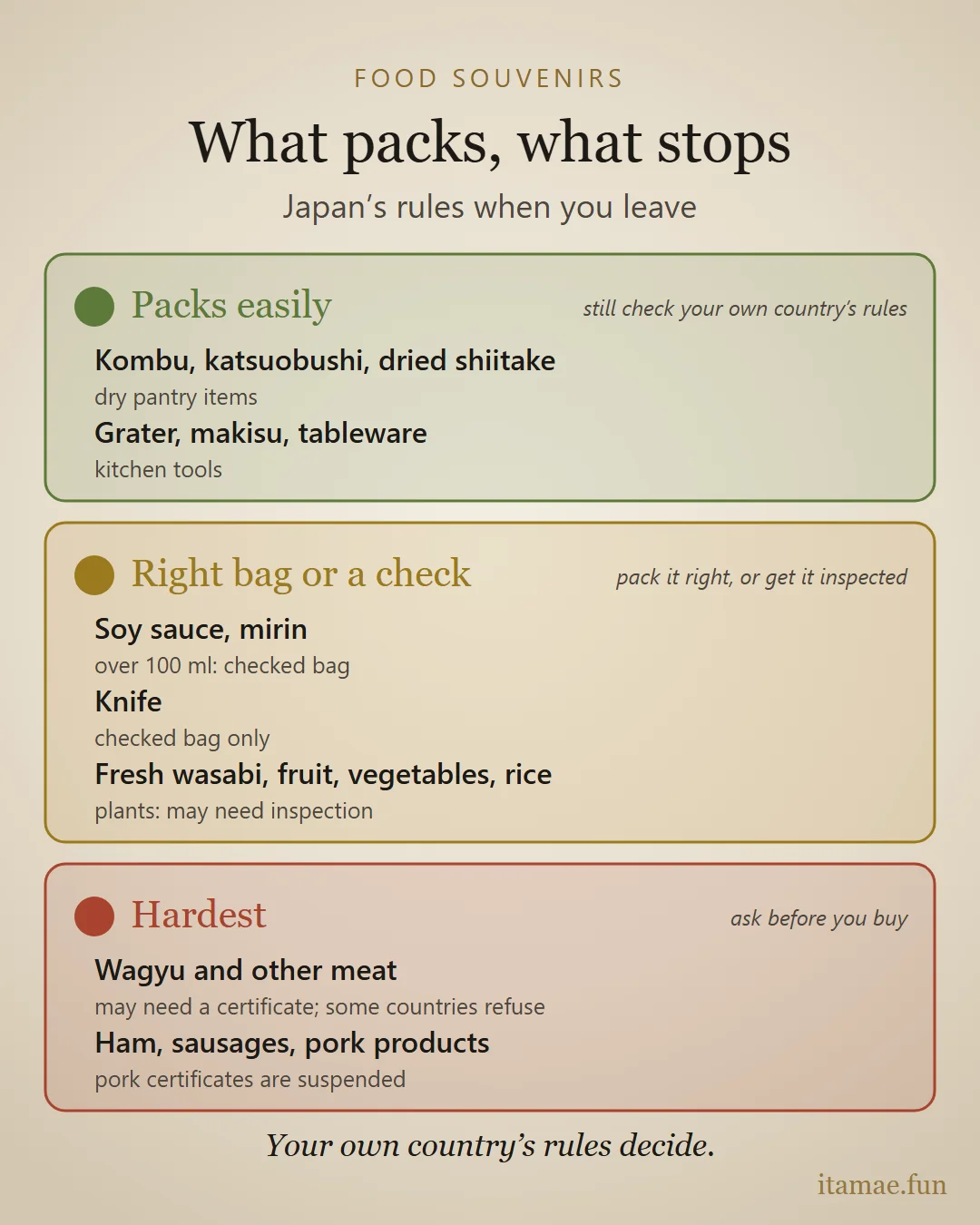
- Pack dry pantry items and kitchen tools. Kombu, katsuobushi, dried shiitake, a grater, a makisu, a knife and a whetstone are what I would bring home.
- Liquids go in your checked bag. On international flights from Japan, carry-on liquids must be in containers of 100 ml or less, in one 1-liter clear bag. Soy sauce and mirin bottles go in the suitcase.
- Knives go in your checked bag, never in your carry-on.
- Meat is the hardest. Wagyu, ham and other meat products may need an export certificate from Japan, and some countries do not accept them at all. Certificates for pork and wild boar products from Japan are currently suspended.
- Fresh plants need checking too: fresh wasabi, fruit, vegetables and rice may need an inspection, or may be banned where you live.
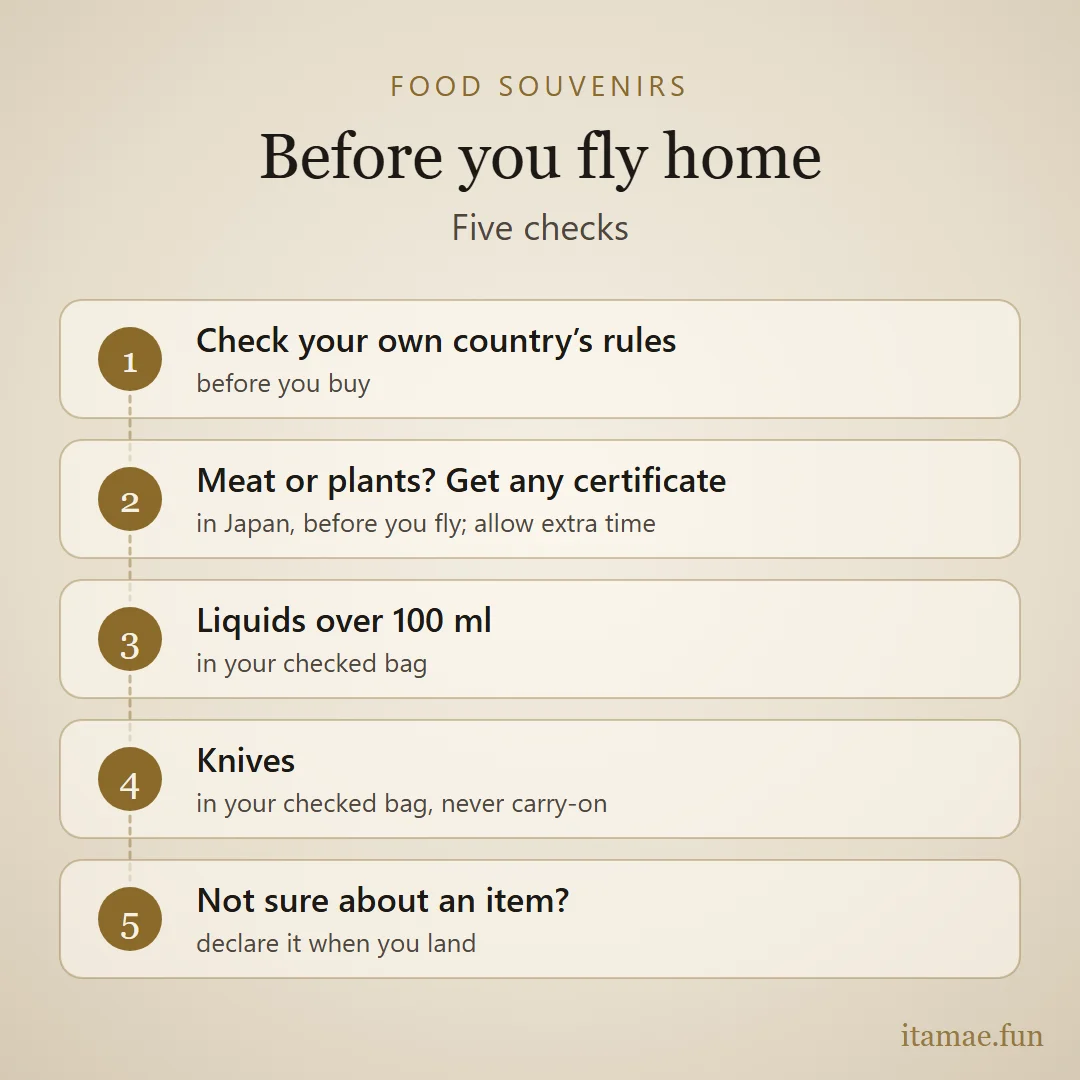
- Check your own country’s rules before you buy.
First, the rules: who decides what
Three sets of rules meet at the airport:
1. Your destination’s rules. Japan’s Animal Quarantine Service tells travelers to confirm with the quarantine authorities of the destination country whether an item can be brought in, and what certificate it needs. Japan’s Plant Protection Station says the same for plants. This is the rule that matters most, and it is different in every country.
2. Japan’s export checks. If your destination requires a certificate, you get it in Japan before you leave:
- Animal products (meat, ham, sausages and so on): an export quarantine inspection at the Animal Quarantine Service before departure. If the destination has suspended imports from Japan, no certificate can be issued. Because classical swine fever has been found in Japan, certificates for pork and wild boar products are currently suspended.
- Plants (fruit, vegetables, plants, and some processed goods made from plants, such as flour and coffee): an export inspection at a plant protection office, or at an export quarantine counter in a major airport, before you fly. The Plant Protection Station warns that inspections can take time, so arrive early.
Both offices advise asking in advance. Paperwork differs by destination, and some checks take time.
3. Airport security. On international flights from Japan, each liquid in your carry-on must be in a container of 100 ml or less, all in one clear, resealable bag of up to 1 liter per person. Semi-liquid foods such as pudding and yogurt count too. Larger bottles can go in your checked baggage. Duty-free items bought after security can be carried on, but if you change planes abroad, they may be taken at the next security check, so ask your airline.
The pantry: what I would pack
These are the food souvenirs I would choose as a cook: dry ingredients for dashi, and good seasonings packed in the suitcase.
Kombu (昆布). Dried kelp, rich in glutamic acid. It is the base of dashi, and kombu dashi is the vegetarian kind. It is dry and flat, so it packs easily. It is a plant product, so check your country’s rules.
Katsuobushi (鰹節). Bonito that is simmered, smoked and dried, then shaved into flakes. Together with kombu it makes the classic dashi: the two kinds of umami work together. It is a fish product. Some countries limit animal products, so check before you pack it.
Dried shiitake (干し椎茸). Dried mushrooms, rich in guanylic acid. Soaked in water, they make shiitake dashi, often combined with kombu for a vegetarian stock.
Soy sauce and mirin. Good seasonings are worth carrying, but they are liquids. Bottles over 100 ml go in your checked baggage, wrapped well. Real mirin (hon-mirin) is about 14% alcohol, so your country’s rules on alcohol may apply.
Wasabi. If you buy a tube or powder, read the label. Under Japan’s labeling rules, ingredients are listed heaviest first. If 本わさび (hon-wasabi) comes first, true wasabi is the main ingredient; if 西洋わさび (seiyo wasabi, horseradish) comes first, horseradish is. Powdered wasabi (粉わさび) is mainly horseradish.
A fresh wasabi root is a plant. It may need an inspection, or it may be banned where you live. If you can take it home, Shizuoka Prefecture says a leftover root, wiped dry, wrapped tightly and kept in the fridge, tastes good for about one month.
Kitchen tools: the souvenirs that last
Food is eaten in a week. A good tool stays in your kitchen for years.
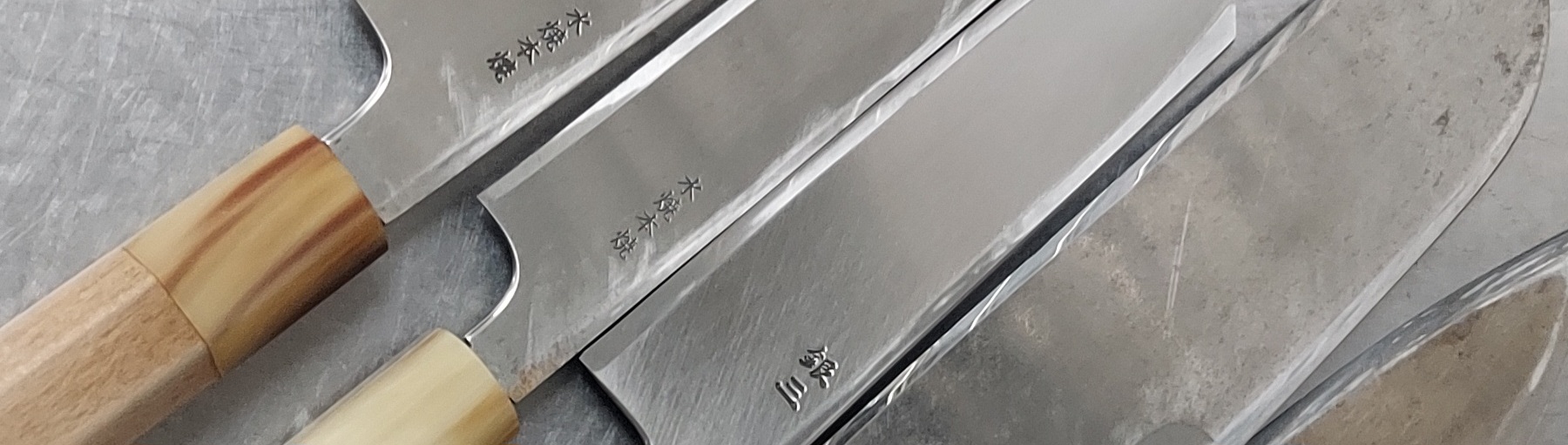
- A Japanese knife. Pack it in your checked baggage, in its saya or box, never in your carry-on. Many shops can engrave a name on the blade. My guide covers choosing one, tax-free shopping and flying home: How to Buy a Japanese Knife in Japan.
- A whetstone. If you buy only one, buy a medium stone, around #1000. See my Whetstone Grit Guide. Stones are heavy, so plan your luggage.
- A grater (oroshigane). My glossary describes it as a grater for daikon, wasabi and ginger, made of copper or stainless steel. For wasabi, choose fine teeth.
- A makisu. A bamboo mat for rolling and shaping sushi rolls. Light and flat.
- A hangiri. A shallow wooden tub for sushi rice. The wood absorbs extra moisture, so the rice does not get sticky. Bulky, so choose the size for your suitcase.
- Tableware and chopsticks. Small plates and bowls pack well if wrapped well.
Wood and bamboo are made from plants. Some countries inspect plant-based goods, so check your own rules for these too.
Not flying with a knife? Browse Japanese knives that ship from Japan
What to skip, or check very carefully
| Item | Why | What to do |
|---|---|---|
| Wagyu and other meat | May need an export quarantine certificate; some countries have suspended meat from Japan | Ask the Animal Quarantine Service at your airport and your country’s quarantine authority before you buy |
| Ham, sausages and pork products | Certificates for pork and wild boar products are currently suspended | Do not plan on bringing them where a certificate is needed |
| Fresh fruit and vegetables | Plants: may need an export inspection, or be banned | Check the Plant Protection Station’s search for your destination |
| Rice | A plant product | Check your own country’s rules |
| Large bottles in your carry-on | Over 100 ml | Put them in your checked baggage |
| A knife in your carry-on | Not allowed in the cabin | Checked baggage only |
If you are not sure about an item, the safest choice is not to buy it, or to declare it when you arrive home.
How to check your own country’s rules
- Search your country’s customs and agriculture (quarantine) websites for “bringing food into” your country. Look for meat, dairy, eggs, fish, plants and seeds.
- For plants, Japan’s Plant Protection Station has a simple search for travelers: you choose your destination from a list.
- For meat and other animal products, contact the Animal Quarantine Service at your departure airport before you travel.
- For alcohol, check your country’s rules and allowance. Sake is alcohol, and so is real mirin (about 14%).
- When you land, declare food if your country asks you to.
FAQ
Can I take wagyu home from Japan?
Only if your country accepts meat from Japan and you have the certificate it requires, issued by Japan’s Animal Quarantine Service before you leave. Some countries have suspended meat from Japan. Check both sides before you buy.
Can I bring soy sauce in my carry-on?
Only in containers of 100 ml or less, in one 1-liter clear bag. Larger bottles go in your checked baggage.
Can I take a Japanese knife home?
Yes, in your checked baggage, never in your carry-on. Check your airline’s rules and your home country’s customs rules.
Is katsuobushi allowed?
It depends on your country. It is a fish product, and some countries limit animal products. Check your own country’s rules.
Can I bring a fresh wasabi root?
It is a plant, so it may need an inspection or be banned. Check your country’s rules, and Japan’s Plant Protection Station if a certificate is needed.
What is the safest food souvenir?
Dry pantry items and kitchen tools, after you have checked your country’s rules.
Summary
The best Japanese food souvenirs for a cook are dry and long-lasting: kombu, katsuobushi, dried shiitake, and tools such as a knife, a whetstone, a grater and a makisu. Seasonings in bottles go in your checked bag. Meat is the hardest: it may need a certificate from Japan, some countries refuse it, and pork certificates are suspended. Fresh plants may need an inspection. Above all, your own country’s rules decide, so check them before you buy, and declare anything you are unsure of.
Read next:
– How to Buy a Japanese Knife in Japan – Whetstone Grit Guide: Which Stone Should You Use? – Japanese Knife Types and Names, Explained by a Working Itamae – Kaiseki Explained by an Itamae: The Course Order and the Words on the Menu
Sources:
– MAFF Animal Quarantine Service, Take out Animal Products from JAPAN: https://www.maff.go.jp/aqs/english/product/export.html – MAFF Animal Quarantine Service, 肉製品等の海外への持ち出し (Japanese): https://www.maff.go.jp/aqs/tetuzuki/product/aq1.html – MAFF Plant Protection Station, taking plants abroad (Japanese): https://www.maff.go.jp/pps/j/trip/top14.html – MAFF Plant Protection Station, flow chart for taking plants abroad (Japanese PDF): https://www.maff.go.jp/pps/j/trip/pdf/export_root.pdf – MLIT, Q&A on liquids on international flights (Japanese PDF): https://www.mlit.go.jp/common/000015937.pdf – itamae.fun, glossary of Japanese cuisine terms (Japanese): https://itamae.fun/japanese-cuisine-terms/